


New Orleans, November 19-23, “Ghosts”
SANA Special Events
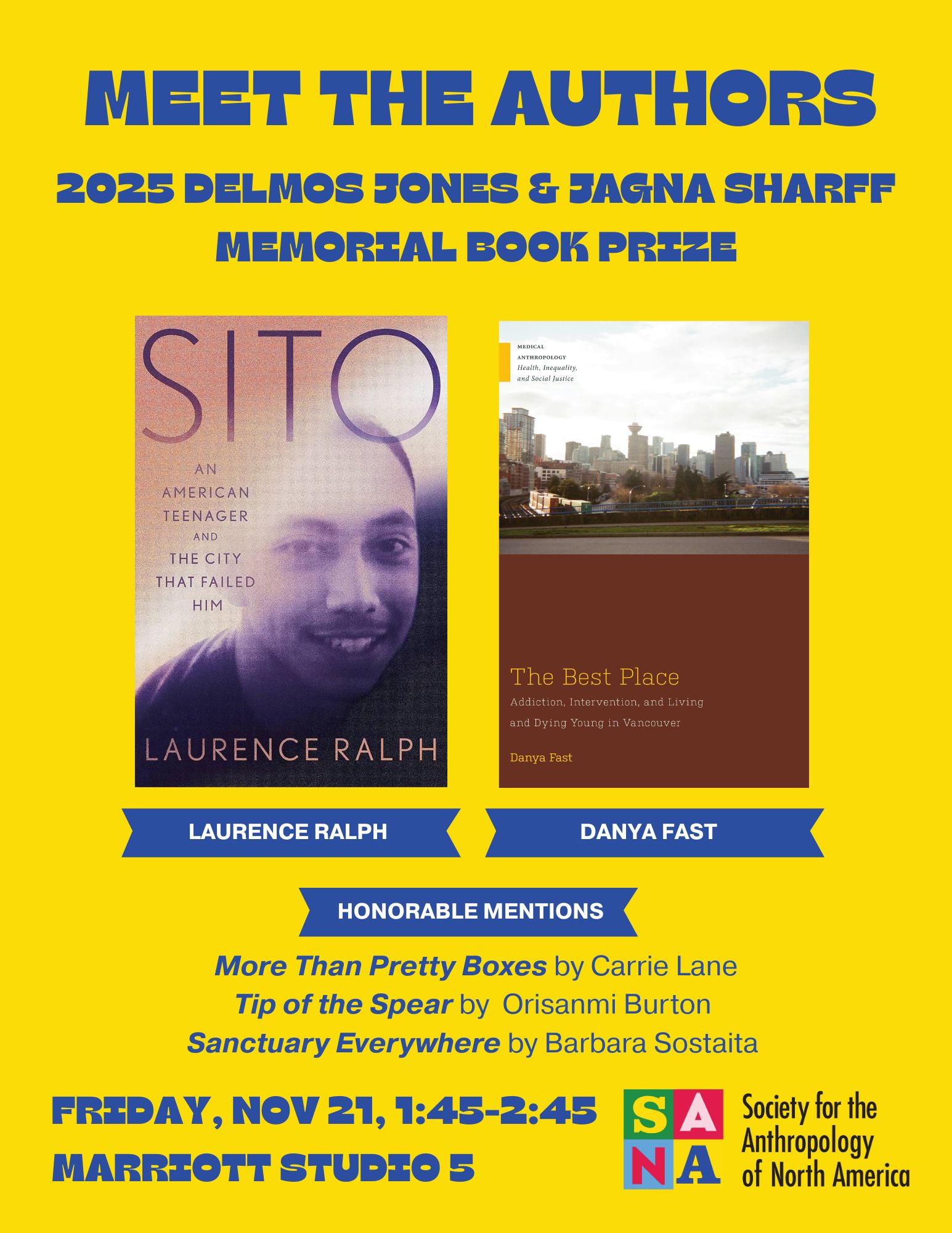
Meet the Authors: 2025 SANA Delmos Jones and Jagna Sharff Memorial Book Prize
Friday, 11/21: 1:45-2:45
Come celebrate the winners and honorable mentions of the Society for the Anthropology of North America’s 2025 Delmos Jones and Jagna Sharff Memorial Book Prize! SANA awards this year’s prize to Established Scholar Laurence Ralph for Sito: An American Teenager and the City that Failed Him (Grand Central Publishing, 2024) and to Emerging Scholar Danya Fast for The Best Place: Addiction, Intervention, and Living and Dying Young (Rutgers U. Press, 2024). Honorable Mentions go to Carrie Lane in the Established Scholar category for More Than Pretty Boxes: How the Rise of Professional Organizing Shows Us the Way We Work Isn’t Working (U. Chicago Press, 2024) and to two authors in the Emerging Scholar category: Orisanmi Burton for Tip of the Spear: Black Radicalism, Prison Repression, and the Long Attica Revolt (U. California Press, 2023) and Barbara Sostaita for Sanctuary Everywhere: The Fugitive Sacred in the Sonoran Desert (Duke U. Press, 2024). Learn about the prize committee’s selection process for this biannual prize, which considered books published in 2023 and 2024. Join us in celebrating the nominees, hear this year’s winners speak about their books, and bring your copy to have it signed by the author!
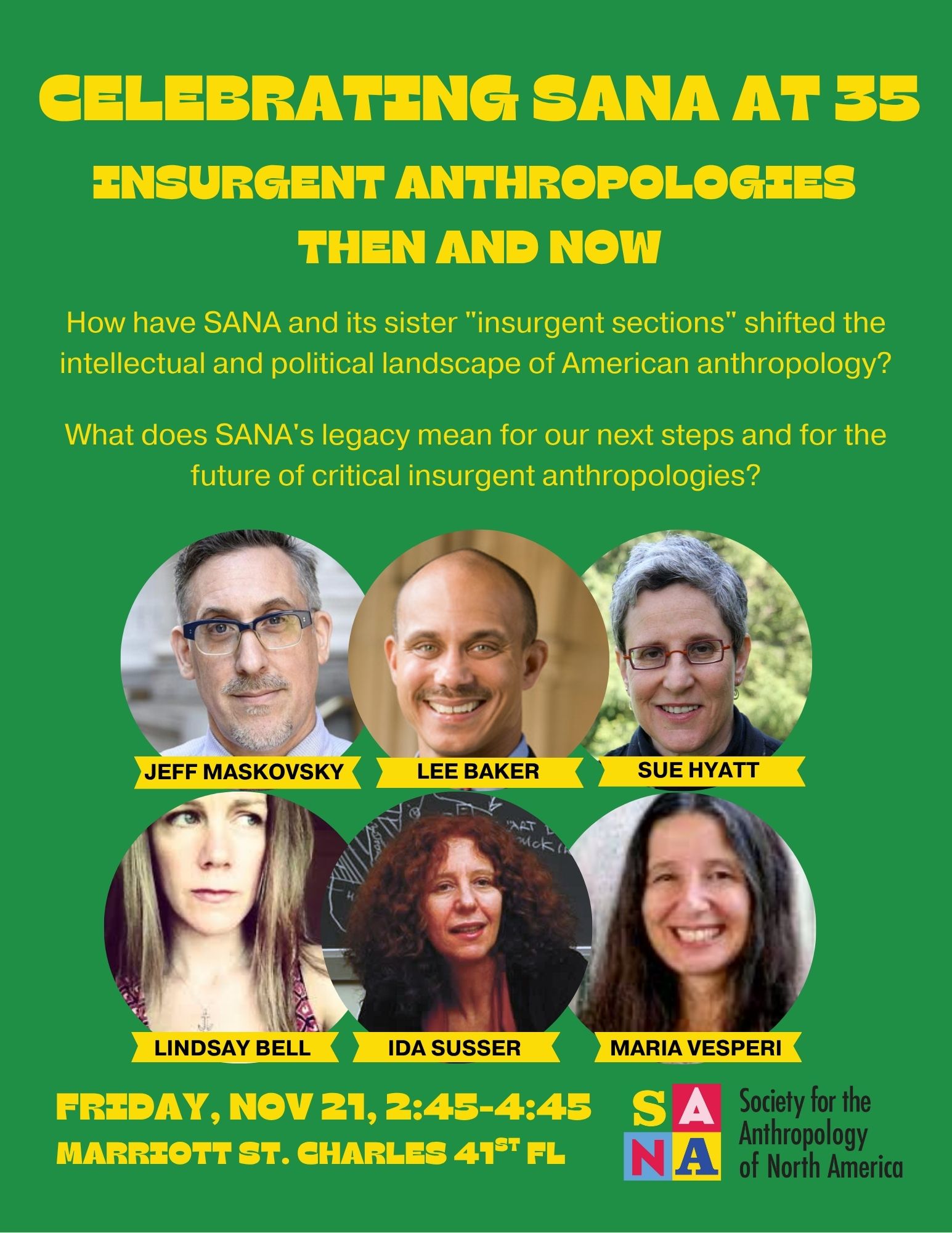
Celebrating SANA at 35: Insurgent Anthropologies Then and Now
Friday, 11/21: 2:45-4:45
Thirty-five years ago, right here in New Orleans, near one hundred people crowded into a 1990 AAA Annual Meeting room to demand the creation of a new section that would recognize the existence of an anthropology of North America. Angry and frustrated that their ethnographic research here “at home” was deemed outside the purview of anthropology, limiting their access to grants, publication opportunities, jobs, and professional recognition, they began to organize for change. In 2025, facing challenges both familiar and distinct, a new generation of anthropologists seeks to learn from the strategic efforts of SANA’s past. How have SANA and its sister “insurgent sections” of the AAA shifted the intellectual and political landscape of the association, and of the discipline more broadly? What does SANA’s legacy mean for our next steps and for the future of critical insurgent anthropologies? Join this roundtable of longtime SANA founders and builders to root our ongoing struggles in our shared insurgent foundations. Roundtable Participants: Lee D. Baker, Lindsay Bell, Sue Hyatt, Jeff Maskovsky, Ida Susser, and Maria Vesperi
SANA Graduate Student Social
Friday, November 21, 4:45-6:00
Marriott Hotel Lobby
Following our “Celebrating SANA at 35” roundtable, SANA graduate student representatives Isabel Abarca (UNC-CH) & Nicole Smith (UCLA) will host a graduate student social. This will be a great opportunity to meet fellow SANA student members and consider what we, as junior scholars, imagine for the future of SANA. With the celebration of 35 years of SANA, there is renewed interest in the section’s past and energy for intergenerational relationship-building looking toward the future. A SANA mentorship program is soon to launch and will be informally introduced during this social. We hope you can join us in guiding SANA to more meaningfully engage and support students!
Memory Work @ The John Thompson Legacy Center
Co-Curating Movement Archives with Incarcerated and Formerly Incarcerated People
Friday Nov 21, 6:00-7:30 at the John Thompson Legacy Center in the 7th Ward, 1212 St. Bernard
Off-site community workshop hosted by SANA + ABA
This event convenes three New Orleans-based organizations that center the experiences and leadership of incarcerated and formerly incarcerated people to shine a light on the lives of those who endure under “life without parole” sentences. Anthropologists will gather at the John Thompson Legacy Center to learn from and be in conversation with leaders from Freedom to Grow and The Visiting Room about their archival projects. This conversation will serve as the material to amplify awareness of Louisiana’s particular carceral histories, including as a site of longstanding activism and solidarities against human rights abuses such as the use of solitary confinement / Closed Cell Restriction and radical sentencing measures. As practitioners skilled in holistic and comparative approaches to social problems, and with an appreciation for the nuances of narrative in cultivating connection and belonging, anthropologists are invited to learn about and support this work.
Freedom to Grow & John Thompson Legacy Center https://www.growingabolition.com/jtlc
Solitary Gardens, https://solitarygardens.org/about
The Visiting Room Project, https://www.visitingroomproject.org/
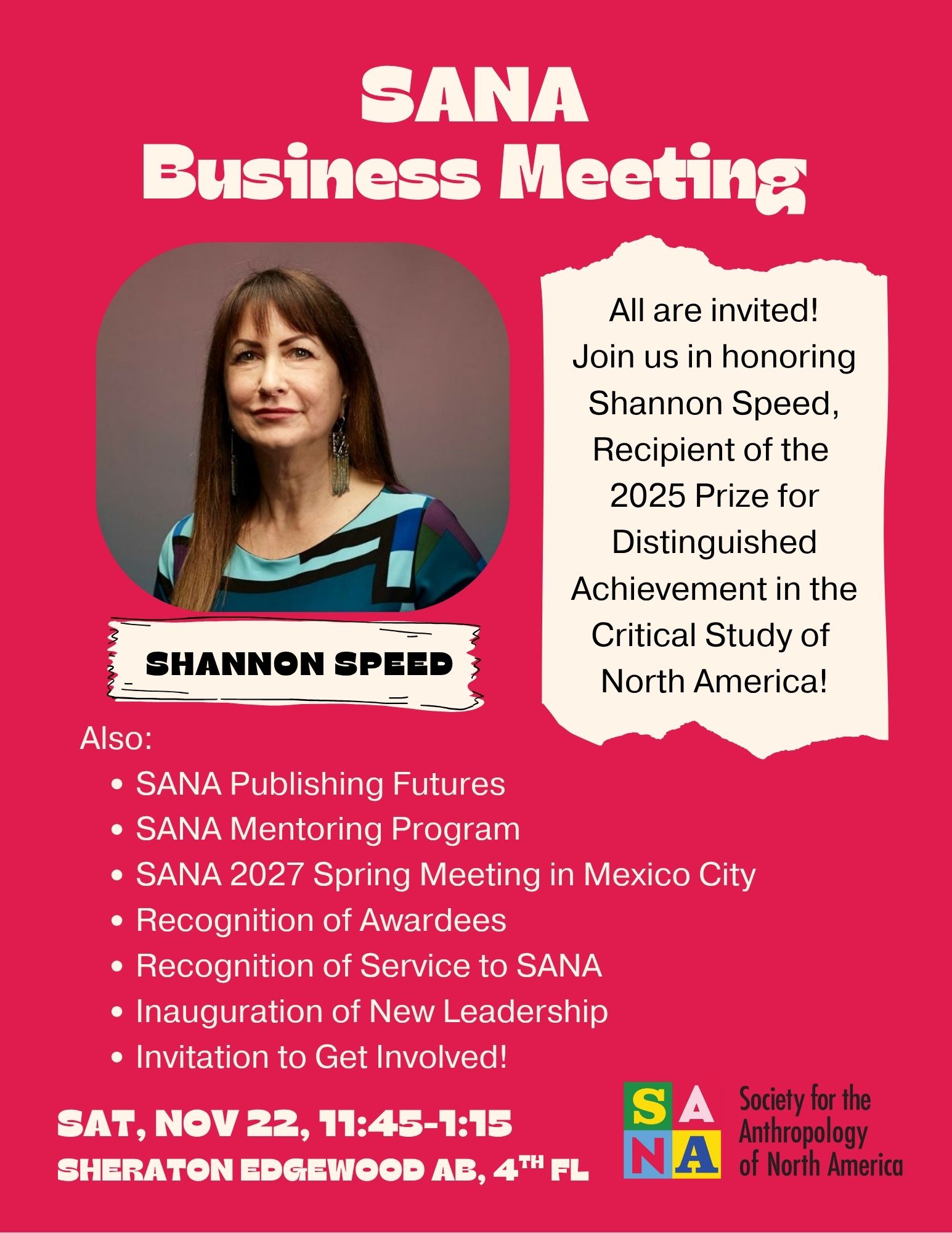
SANA Business Meeting
Saturday, 11/22: 11:45-1:15
The Society for the Anthropology of North America encourages all members and friends to attend our annual business meeting. Topics to be discussed include: SANA publishing futures; Building a SANA mentoring program and other support for student and early career members; Planning the 2027 SANA Spring Meeting in Mexico City; Celebrating Shannon Speed, recipient of the 2025 Prize for Distinguished Achievement in the Critical Study of North America; and Inaugurating new leadership. We will also open the floor for other member initiatives and concerns. Please join us!
SANA Sponsored Sessions
|
Outside the Resilience Frame: Writing on Immigrant Endurance in Un-endurable Times Thursday, November 20, 8:30-10:00 Sheraton Grand Ballroom D (5th fl) Organizers: Elizabeth Rubio and Amelia Frank-Vitale Participants: Xitalli Alvarez Almendariz, Carlos Martinez, Ola Galal, Gilberto Rosas, Cecilia Vasquez Co-Sponsor: Association of Latina/o and Latinx Anthropologists This roundtable brings together activist-engaged scholars rethinking the contours of immigrant justice narratives. In the virulent anti-immigrant present, we see clearly the collapse of the myth of the good (enough) immigrant juxtaposed with the bad/criminal immigrant, revealing that concerns about the law, good behavior, coming here the “right” way, was always a pretense. Anthropologists have long struggled with how to explore, analyze, and collaboratively share stories of migrants; striving to find balance between recognizing pain and power. There is a growing concern, however, about the utilization of resilience as a framework for migration; as resilience necessitates violence which creates a concerning dynamic of fetishizing pain. As anthropologists writing in other contexts have argued (Bonilla and Lebrón 2019), resilience narratives easily become alibis for structured abandonment, transforming the measure of “good citizenship” in the neoliberal age to one’s capacity to “stick it out well” (Hage 2013). In this roundtable, we seek to trouble the ideology of immigrant resilience. We ask: How might anthropologists reconcile imperatives to honor the agency of individual immigrants, while attending to the structural violences with which they must contend, and the need to build collective power that challenges those violences at their roots? Within our writing, how do we refrain from the denials of coevalness (Fabian 1983) that necessarily attend to resilience framings? How do interlocutors themselves react to framings of their stories in this way? |
| New Ethnographies of the US Carceral State: Authors Meet Readers
Friday, November 21, 10:00 Sheraton Grand Ballroom D (5th fl) Organizer: Megan Raschig Participants: Heath Pearson, Melissa Burch, Damien Sojoyner, Megan Raschig, Catherine Besteman, Kristin Doughty Co-Sponsor: Critical Urban Anthropology Association Until recently, anthropological attention to systems of policing, confinement and control in the United States have been modest. This roundtable will feature a discussion of three new ethnographic monographs that explore distinct aspects of the US carceral state. “The Criminal Record Complex: Risk, Race and the Struggle for Work in America,” by Melissa Burch, chronicles the daily interactions of hiring managers, workforce development professionals, and job-seekers with felony convictions in the Southern California, revealing a set of actors, institutions and industries that stand to benefit from the erroneous idea that people with criminal records are dangerous to employ. “Life beside Bars: Confinement and Capital in an American Prison Town,” by heath pearson, illuminates an alternative history of the unruly and unexpected ways that people resist, get by, make money and, most especially, build radical social life beside systems of large-scale confinement. “Healing Movements: Chicanx-Indigenous Activism and Criminal Justice in California,” by Megan Raschig, tracks a grassroots abolitionist project cultivated by formerly incarcerated women and men, whose praxis of cultural healing centers mutuality and joy while countering local correctional institutions and more pervasive carceral logics of deficit and disposability. Comprised of six anthropologists (Catherine Besteman, Melissa Burch, Kristin Doughty, heath pearson, Megan Raschig, and Damien Sojoyner), this roundtable will engage in dialogue centered around the many intersections of the books: from the haunt of confinement ordering the land to the afterlives of convictions haunting people trying to find work; through the generation of novel practices of care and worldbuilding against and beyond the non-profit industrial complex; between the forces of abolition and the baby steps of reforms; and, amidst the struggles for survival and the futures made through solidarity and with joy. |
| Ghosts of Empire
Saturday, November 22, 12:45-2:15 Marriott Galerie 2 Organizers: Roger Lancaster and Andrew Bickford Participants: Jeff Maskovsky, Genevieve Negrón Gonzales, Rhoda Kanaaneh, Andrew Bickford, Roger Lancaster, David Price, Aziza Bayou The empire has seen better times. Or so it would seem. In the nineteenth and early twentieth century, the US had been a continent-wide empire guided by an expressly white ethno-nationalist vision of Manifest Destiny. It was expansionist, protectionist, and mercantilist; isolationist with regard to European disputes but interventionist in its own hemisphere. A different sort of empire took shape at the end of World War II, when the US emerged from the war with global military dominance and its economy accounted for half the world industrial output. Under Pax Americana, the bipartisan consensus was liberal, internationalist, and constitutionalist. In the arsenal of imperial persuasion were not only forms of brute coercion but also various forms of soft power, the ideal of rule of law, and an outsized cultural influence. Anchored in a modern administrative state, the global policeman’s internal policies were mildly redistributive — organized labor was on a strong footing from the late 1930s until the early 1980s — and increasingly guided by one variant or another of race-ethnic liberalism. Both parties tamped down social movements and political currents on the far right (such as Lindbergh’s “America First” conservatism) and the socialist left (especially but not only the Communist Party during the McCarthy era). These arrangements are presently being dismantled. What comes next? A diverse panel of discussants working in different venues at different stages in their careers, we will discuss aspects of a present haunted by the past, surveying military techniques, satellite states, soft power, race-ethnic imaginaries, labor organization, migration, and the role of law. Among the questions we consider: What conceptual models might be up to the challenge of the moment? How do earlier, pre-World War versions of empire inform the thinking of the contemporary right, and does the left remain trapped in later versions of Pax Americana? Do Cold War and post-Cold War frames continue to offer explanatory power under current conditions? Should we criticize today’s right, which openly declares its dictatorial ambitions, with institutional logics that the left once called elitest or imperialist? Will present-day rearrangements and the evisceration of the administrative state reverse the empire’s decline — or hasten its demise? Bertolt Brecht once said, “Build not on the good old days but on the bad new ones.” Is the left trying to bust the ghosts of the past when we should be confronting the monsters of the present? |